
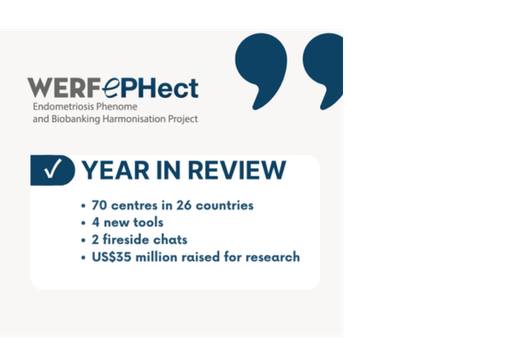

69 centres in 26 countries are now utilising EPHect tools
EPHect centres.png)
Recording of the fireside chat between professor Erin Greaves and post-doctoral fellow Danielle Peterse is now available
Watch the fireside chat.png)
Recording of the fireside chat between professor Idhaliz Flores and assistant professor Mira Mousa is now available
Watch the fireside chat.png)
Molecular Human Reproduction publishes SOPs for heterologous, homologous, pain, and organoid models
Learn more.png)
In this WESinar (video) the innovators of EPHect share the background and an overview of the tools that are revolutionising endometriosis research
Watch video now
The purpose of the Endometriosis Phenome and Biobanking Harmonisation Project (EPHect) is to enable large-scale, cross-centre, epidemiologically robust research into the causes of endometriosis, novel diagnostic methods, and better treatments, through the development of:
The EPHect collaboration, originally involving 34 academic institutions and three medical/diagnostic companies, is a landmark in endometriosis research worldwide. Its global consensus of standardised data collection instruments and sample collection protocols were published in 2014. A standard tool for physical examination assessment was added in 2024, and SOPs for experimental models were published in 2025.
The tools are designed to facilitate the design and interpretation of collaborative studies across the entire endometriosis research field, including studies into its pathogenesis and identification of disease sub-types; biomarker and targeted treatment discovery; and assessment of treatment outcome/effectiveness in clinical trials. To date 69 institutions in 26 countries are registered as users of the tools.
This website portal includes up-to-date information on the EPHect tools and SOPs, and provides the opportunity for feedback (much welcomed!) and external submission of new/amended protocols allowing for the application of novel technologies.
In addition, this website includes a registry of centres using EPHect tools.
Based on user feedback, as well as further systematic searches, these tools will be reviewed every three years and updated where necessary.
The University of Pennsylvania is working towards validating a novel blood marker for atypical endometriosis investigating risk of ovarian cancer. They seek global collaboration from EPHect sites with banked serum/plasma with histologically confirmed atypical endometriosis.
If your centre has relevant biospecimens and patient volume, please contact Kate O’Neill.
© 2014-2026 ephect.org